An authentic recipe and comprehensive guide for making a traditional Valencian-style seafood and chicken paella that serves 12 hungry adults.
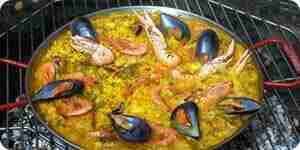
Authentic Valencian-Style Seafood and Chicken Paella Recipe for 12 Hungry Adults
Authentic Valencian-Style Seafood and Chicken Paella
Paella: 1
Paella (Pan) Size: 16 in. diameter
Servings per paella: 12 adults
ANTHROPOLOGY, ETYMOLOGY, AND OTHER SILLY STUFF ABOUT PAELLA
The recipe for this exquisite Valencian paella (from the Latin "pagella," a circular, semi-cylindrical container with one or two hoop-shaped handles, which evolved into the Castilian Spanish "paella," the actual name of the pan in which the famous dish is cooked) is based on René's mother's recipe and includes a splendid array of herbs, vegetables, seafood, and mild spices. Freshly picked green spices work best. This Valencian paella is best accompanied by a good Spanish Gran Reserva Rioja wine or a California Rhine wine.
The number of servings may look large, but paella is meant to be shared with relatives, friends, coworkers, and club or church members, or sold at a fundraiser. For a different number of paellas or servings, change the amount of ingredients proportionally. Paella can be served at lunch or supper.
Making paella may look laborious and complicated, but it is a fun and unique experience that the entire family can participate in and enjoy. As a matter of fact, a collaborative approach is the best way to make paella, where several people prepare the ingredients simultaneously around a workspace—the adults sipping good wine, and the kids enjoying good fruit juice.
Furthermore, parents and children can enjoy quality family time together while nibbling and snacking on the paella garnishes.
Moreover, children can learn a little culinary anthropology from their parents through the diverse ingredients in the paella, where the "old" and "new" worlds merge in a harmonious and flavorful convergence.
Versed Spanish culinary anthropologists assert that paella originated in the Spanish region of Valencia, specifically around The Albufera (from the Arabic "Al-Buhayrah," literally "The Little Sea," dating back to the Moorish occupation of Spain), a small coastal, low-land saline lake—practically a lagoon—about 12 miles south of the Balearic-Mediterranean seaport city of Valencia, the region's capital.
They contend that paella originated from thrift; it was basically born as a well-garnished rice dish to which the previous day's leftovers of pork, rabbit, or poultry were added. Eventually, it came to be prepared with combinations of fresh cuts of any of those three meats, which were plentifully available in the surroundings of The Albufera. Later on, seafood was used instead of, or in addition to, any combination of the traditional meat trio, but a lack of refrigeration prevented seafood from becoming the dominant component of paella as it is today.
The story goes that the day after reveling with plenty of wine and the traditional meat trio, villagers would rapidly cook rice in a paella pan, then toss and stir in the previous day's leftovers so they had something quickly cooked to accompany the desperately needed wine to cure their hangovers.
The problem was that these self-curing villagers would usually get another hangover the next day, as they typically prescribed themselves a mighty large dose of wine as part of the cure. They would continue this the next day, finishing the paella as a "cure for the cure." Thus, paella was part of a two-day remedy. Seafood paella wouldn't last and would spoil by the next day due to a lack of refrigeration.
The bottom line is that nowadays seafood dominates paella, and the greater the variety of seafood, the merrier. For instance, this recipe calls for rock cod or hake, squid, mussels, baby clams, prawns, Dungeness crabs, lobster tails, and chicken breasts. Bayou crawfish make an excellent substitute for prawns.
As for vegetables and mild spices, we go all out. Besides pricey saffron—which can be replaced with turmeric or yellow food coloring slightly tinted with achiote (annatto)—this recipe calls for Spanish capers, green olives, garbanzo beans, sweet peas, cilantro, parsley, and garlic, just to mention a few.
All that said, paella is a joyful tribute to life, as eloquently expressed by its eclectic yet harmoniously balanced collection of ingredients.
If there is no Spanish specialty store in your community, some of the ingredients, such as large Spanish capers and achiote, can be found in Mexican grocery stores. Saffron can be found in Middle Eastern stores. Aside from dedicated fish markets, Chinese grocery stores are usually a reliable source for fresh seafood.
The following sections provide meticulously detailed lists of utensils, ingredients, and step-by-step instructions that empower even the rawest of novices to excel as a master chef in the culinary art of making paella.
Furthermore, the ingredients are listed in related groups to facilitate shopping; as structured, the ingredient list provides a convenient, orderly shopping guide.
Finally, a few words of caution: (1) Paella must be cooked over an open fire, never baked; (2) the rice must be cooked in such a way that it results in a dry and loose grain; (3) be suspicious of any mushy or wet paella; and (4) never accept beef in paella.
COOKING UTENSILS
a) Cleaver
b) Cutting knife
c) Cooking brush
d) Cooking spoons
e) Utility knife
f) Cutting board
g) Cooking spatula
h) Paella pan
i) Medium-sized pot for seafood stock
j) Large pot to cook crabs
k) Measuring cup
l) Measuring spoons
m) Kitchen mitts
n) Full-body apron
LIST OF INGREDIENTS
NOTES
· To minimize the probability of bacterial contamination, wash your hands thoroughly with soap under running water after touching uncooked seafood or poultry.
· Keep all uncooked seafood and poultry refrigerated at all times except at the very moment of cleaning, cutting, or cooking.
· Increase the amount of ingredients proportionally for a larger size or number of paellas.
· Make sure all ingredients are prepared, measured, and placed in separate containers prior to starting cooking.
· You can use the head, tail, and bones of the filleted fish as a substitute for the bouillons in the stock. To that effect, inform your butcher of your intentions and ask them to cut and clean the fish accordingly.
Seafood and Poultry
2 pounds of live baby clams, with scrubbed-clean shells
2 pounds of live mussels, with scrubbed-clean shells and de-bearded
2 pounds of boneless chicken breast, cut into 2-cubic-centimeter chunks
2 pounds of fish fillets (rock cod, hake, or any fish with a firm texture that can endure stirring during cooking), cut into 2-cubic-centimeter chunks
2 pounds of cleaned squid tentacles and tubes, whole or cut into 2-centimeter-wide rings
1 pound of large prawns or crawfish, shelled and deveined
3* cooked Dungeness crabs or any type of meaty crabs—legs and pincers left whole, but the body cut into 4 pieces
3* cooked, shelled lobster tails, cut into 2-cubic-centimeter chunks
* Better if live and cooked at home
Herbs, Vegetables, and Spices
2 cups of fresh onions, chopped
1 cup of fresh leeks, chopped
1 cup of fresh scallions, chopped
2 heads of fresh garlic, minced
12 fresh mushrooms, sliced
6 fresh mint leaves, minced
6 fresh basil leaves, minced
10 fresh oregano leaves, minced
1 twig of fresh thyme
1 cup of fresh baby sweet peas in the pod, cleaned and deveined
1 cup of fresh baby fava beans in the pod, cleaned and deveined
2 fresh red (pimento) peppers, seeded and cut into strips
2 large tomatoes, diced into 1-cubic-centimeter chunks
2 cups of fresh parsley, chopped
1 cup of fresh cilantro, chopped
2 bay leaves, whole
1 cup of cooked canned garbanzo beans, thoroughly drained
2 cups of bottled Spanish green olives, thoroughly drained
1 cup of bottled large Spanish capers, thoroughly drained
2 cups of canned artichoke hearts, thoroughly drained
1 teaspoon of celery seed
4 cloves, whole
1 pinch of saffron (or 1 teaspoon of turmeric, or 3 drops of yellow food coloring and 1 teaspoon of achiote)
1 teaspoon of paprika
1 teaspoon of black pepper, ground
1 cup of olive oil
2 tablespoons of butter
4 cups of long-grain rice
8 cups of water (2 cups for each cup of rice for the paella stock)
1 cup of white wine (for the paella stock)
3 cubes of shrimp-flavored bouillon (for the paella stock)
4 or more ripe lemons, cut into round slices (for decoration)
1 cup of salt or as needed (cooking the crabs will take plenty of salt)
COOKING INSTRUCTIONS
Put your apron on, keep mitts close at hand, and use them when handling hot utensils.
For best results, prepare the ingredients in the order listed here.
A - Seafood Stock
NOTES
· This stock replaces the water normally used in cooking regular rice, requiring 2 cups of water for each cup of rice.
· If you do not have bouillon, use the remnants of the filleted fish as a substitute.
1. Pour the water into the pot.
2. Add the 3 cubes of shrimp bouillon.
3. Add ½ cup of chopped onions (save the rest for the sweated vegetables and the rice).
4. Add ¼ of the minced garlic.
5. Add the celery seeds.
6. Add the cloves.
7. Add the saffron (or 1 teaspoon of turmeric, or 3 drops of yellow food coloring and 1 teaspoon of achiote).
8. Add the paprika.
9. Turn on the heat and bring the stock to a boil.
10. Add salt to taste.
11. Add the butter.
12. Add the mussels and baby clams.
13. Add the white wine.
14. Let the stock return to a boil, and add more salt or water as needed.
15. Lower the heat to simmer the mussels and clams for up to 3 minutes, making sure that all mussels and clams open. DISCARD any mussels or clams that do not open.
16. Remove the mussels and clams and set them aside for later.
17. Set the stock aside for later.
B - Crabs
NOTES
· In case you were able to get live crabs, use a pot large enough to hold the crabs totally submerged in water.
1. Pour 1 gallon of water and two tablespoons of salt per crab into the pot and bring it to a boil.
2. Using mitts, carefully dump the crabs into the boiling water.
3. Bring the water back to a boil.
4. Lower the heat to simmer the crabs for 15 minutes.
5. Using mitts, carefully remove the crabs from the pot. Beware that the crabs and their entrails are hot!
6. Under cold running water, remove the crab limbs and set them aside.
7. Under cold running water, remove the crab shell.
8. Under cold running water, remove the crab gills, jaws, and tail.
9. Clean any yellowish matter off the crab body.
10. Cut the crab body into 4 pieces and set it aside along with the limbs for later.
C - Poultry
1. Pour ¼ of the olive oil into the paella pan and spread it evenly.
2. Raise the heat until the paella pan is steaming hot.
3. Add salt to taste, 1/3 of the black pepper, and ¼ of the minced garlic.
4. Throw in the chicken and fry until it becomes golden brown.
5. Remove the chicken from the paella pan and set it aside for later.
6. Clean the paella pan of any burned residue, particularly those stuck to the surface.
D - Seafood
1. Pour ¼ of the olive oil into the paella pan and spread it evenly.
2. Raise the heat until the paella pan is steaming hot.
3. Add salt to taste, all the remaining black pepper, and ¼ of the minced garlic.
4. Throw in the fish, squid, lobster tails, and prawns or crawfish, and stir-fry the seafood until the squid and fish are done, making sure not to overcook the lobster tails, prawns, or crawfish.
5. Remove the seafood from the paella pan and set it aside for later.
6. Clean the paella pan of any burned residue, particularly those stuck to the surface.
E - Sofrito (Sweated Vegetables)
1. Lower the heat.
2. Pour ¼ of the oil into the hot paella pan as needed.
3. Add the sliced mushrooms.
4. Add 1 cup of chopped onions (save the rest for the rice).
5. Add all the chopped leeks.
6. Add the thyme.
7. Add ¼ of the minced garlic (save the rest for the rice).
8. Add all of the minced mint, basil, and oregano leaves.
9. Add all of the baby sweet pea and fava bean pods.
10. Stir and sweat until the onions reach the proper texture.
11. Remove from the paella pan and set the sofrito aside.
12. Clean the paella pan of any burned residue, particularly those stuck to the surface.
F - Rice
1. Pour ¼ of the oil into the paella pan as needed.
2. Raise the heat until the paella pan is steaming hot.
3. Add the rest of the chopped onions and minced garlic, and fry until golden brown.
4. Add the rice.
5. Stir and fry until the garlic turns golden brown. Do not let the rice stick to the bottom.
6. Add the sofrito (sweated vegetables) and stir well. Do not let the rice stick to the bottom.
7. Add the chicken, squid, and fish, folding gently to avoid breaking the fish apart.
8. Add the butter and stock (2 cups of stock per cup of rice), artichoke hearts, capers, and olives, and fold gently to avoid breaking the fish.
9. Taste the stock and make sure it is salted enough. Add salt if needed, or replace some stock with plain water if it is too salty. Paella, however, should be on the slightly salty side.
10. Lower the heat to simmer the rice until the stock almost completely disappears from sight.
11. At this point, add all the garbanzo beans, scallions, parsley, and cilantro, and gently fold the paella again, making sure it does not stick to the bottom. This should be the last time you stir the paella, lest it become mushy.
12. Adorn the top of the paella with the mussels, baby clams, prawns, lobster tails, and crab pieces.
13. Lower the heat if there are fumes signaling that the bottom of the paella is burning, and let the paella simmer until the rice is completely dry.
14. Adorn the paella with lemon slices arranged in whatever pattern appeals to you or suits the occasion best.
15. Serve the paella while hot and accompany it with a room-temperature good Spanish Gran Reserva Rioja wine or a chilled California Rhine wine.
16. Enjoy the paella today; clean up the kitchen mess tomorrow!
How to Make Authentic Valencian-Style Paella
An authentic recipe and comprehensive guide for making a traditional Valencian-style seafood and chicken paella that serves 12 hungry adults.
Authentic Valencian-Style Seafood and Chicken Paella Recipe for 12 Hungry Adults
Authentic Valencian-Style Seafood and Chicken Paella
Paella: 1
Paella (Pan) Size: 16 in. diameter
Servings per paella: 12 adults
ANTHROPOLOGY, ETYMOLOGY, AND OTHER SILLY STUFF ABOUT PAELLA
The recipe for this exquisite Valencian paella (from the Latin "pagella," a circular, semi-cylindrical container with one or two hoop-shaped handles, which evolved into the Castilian Spanish "paella," the actual name of the pan in which the famous dish is cooked) is based on Rene's mother's recipe and includes a splendid array of herbs, vegetables, seafood, and mild spices. Freshly picked green spices work best. This Valencian paella is best accompanied by a good Spanish Gran Reserva Rioja wine or a California Rhine wine.
The number of servings may look large, but paella is meant to be shared with relatives, friends, coworkers, and club or church members, or sold at a fundraiser. For a different number of paellas or servings, change the amount of ingredients proportionally. Paella can be served at lunch or supper.
Making paella may look laborious and complicated, but it is a fun and unique experience that the entire family can participate in and enjoy. As a matter of fact, a collaborative approach is the best way to make paella, where several people prepare the ingredients simultaneously around a workspace—the adults sipping good wine, and the kids enjoying good fruit juice.
Furthermore, parents and children can enjoy quality family time together while nibbling and snacking on the paella garnishes.
Moreover, children can learn a little culinary anthropology from their parents through the diverse ingredients in the paella, where the "old" and "new" worlds merge in a harmonious and flavorful convergence.
Versed Spanish culinary anthropologists assert that paella originated in the Spanish region of Valencia, specifically around The Albufera (from the Arabic "Al-Buhayrah," literally "The Little Sea," dating back to the Moorish occupation of Spain), a small coastal, low-land saline lake—practically a lagoon—about 12 miles south of the Balearic-Mediterranean seaport city of Valencia, the region's capital.
They contend that paella originated from thrift; it was basically born as a well-garnished rice dish to which the previous day's leftovers of pork, rabbit, or poultry were added. Eventually, it came to be prepared with combinations of fresh cuts of any of those three meats, which were plentifully available in the surroundings of The Albufera. Later on, seafood was used instead of, or in addition to, any combination of the traditional meat trio, but a lack of refrigeration prevented seafood from becoming the dominant component of paella as it is today.
The story goes that the day after reveling with plenty of wine and the traditional meat trio, villagers would rapidly cook rice in a paella pan, then toss and stir in the previous day's leftovers so they had something quickly cooked to accompany the desperately needed wine to cure their hangovers.
The problem was that these self-curing villagers would usually get another hangover the next day, as they typically prescribed themselves a mighty large dose of wine as part of the cure. They would continue this the next day, finishing the paella as a "cure for the cure." Thus, paella was part of a two-day remedy. Seafood paella wouldn't last and would spoil by the next day due to a lack of refrigeration.
The bottom line is that nowadays seafood dominates paella, and the greater the variety of seafood, the merrier. For instance, this recipe calls for rock cod or hake, squid, mussels, baby clams, prawns, Dungeness crabs, lobster tails, and chicken breasts. Bayou crawfish make an excellent substitute for prawns.
As for vegetables and mild spices, we go all out. Besides pricey saffron—which can be replaced with turmeric or yellow food coloring slightly tinted with achiote (annatto)—this recipe calls for Spanish capers, green olives, garbanzo beans, sweet peas, cilantro, parsley, and garlic, just to mention a few.
All that said, paella is a joyful tribute to life, as eloquently expressed by its eclectic yet harmoniously balanced collection of ingredients.
If there is no Spanish specialty store in your community, some of the ingredients, such as large Spanish capers and achiote, can be found in Mexican grocery stores. Saffron can be found in Middle Eastern stores. Aside from dedicated fish markets, Chinese grocery stores are usually a reliable source for fresh seafood.
The following sections provide meticulously detailed lists of utensils, ingredients, and step-by-step instructions that empower even the rawest of novices to excel as a master chef in the culinary art of making paella.
Furthermore, the ingredients are listed in related groups to facilitate shopping; as structured, the ingredient list provides a convenient, orderly shopping guide.
Finally, a few words of caution: (1) Paella must be cooked over an open fire, never baked; (2) the rice must be cooked in such a way that it results in a dry and loose grain; (3) be suspicious of any mushy or wet paella; and (4) never accept beef in paella.
COOKING UTENSILS
a) Cleaver
b) Cutting knife
c) Cooking brush
d) Cooking spoons
e) Utility knife
f) Cutting board
g) Cooking spatula
h) Paella pan
i) Medium-sized pot for seafood stock
j) Large pot to cook crabs
k) Measuring cup
l) Measuring spoons
m) Kitchen mitts
n) Full-body apron
LIST OF INGREDIENTS
NOTES
· To minimize the probability of bacterial contamination, wash your hands thoroughly with soap under running water after touching uncooked seafood or poultry.
· Keep all uncooked seafood and poultry refrigerated at all times except at the very moment of cleaning, cutting, or cooking.
· Increase the amount of ingredients proportionally for a larger size or number of paellas.
· Make sure all ingredients are prepared, measured, and placed in separate containers prior to starting cooking.
· You can use the head, tail, and bones of the filleted fish as a substitute for the bouillons in the stock. To that effect, inform your butcher of your intentions and ask them to cut and clean the fish accordingly.
Seafood and Poultry
2 pounds of live baby clams, with scrubbed-clean shells
2 pounds of live mussels, with scrubbed-clean shells and de-bearded
2 pounds of boneless chicken breast, cut into 2-cubic-centimeter chunks
2 pounds of fish fillets (rock cod, hake, or any fish with a firm texture that can endure stirring during cooking), cut into 2-cubic-centimeter chunks
2 pounds of cleaned squid tentacles and tubes, whole or cut into 2-centimeter-wide rings
1 pound of large prawns or crawfish, shelled and deveined
3* cooked Dungeness crabs or any type of meaty crabs—legs and pincers left whole, but the body cut into 4 pieces
3* cooked, shelled lobster tails, cut into 2-cubic-centimeter chunks
* Better if live and cooked at home
Herbs, Vegetables, and Spices
2 cups of fresh onions, chopped
1 cup of fresh leeks, chopped
1 cup of fresh scallions, chopped
2 heads of fresh garlic, minced
12 fresh mushrooms, sliced
6 fresh mint leaves, minced
6 fresh basil leaves, minced
10 fresh oregano leaves, minced
1 twig of fresh thyme
1 cup of fresh baby sweet peas in the pod, cleaned and deveined
1 cup of fresh baby fava beans in the pod, cleaned and deveined
2 fresh red (pimento) peppers, seeded and cut into strips
2 large tomatoes, diced into 1-cubic-centimeter chunks
2 cups of fresh parsley, chopped
1 cup of fresh cilantro, chopped
2 bay leaves, whole
1 cup of cooked canned garbanzo beans, thoroughly drained
2 cups of bottled Spanish green olives, thoroughly drained
1 cup of bottled large Spanish capers, thoroughly drained
2 cups of canned artichoke hearts, thoroughly drained
1 teaspoon of celery seed
4 cloves, whole
1 pinch of saffron (or 1 teaspoon of turmeric, or 3 drops of yellow food coloring and 1 teaspoon of achiote)
1 teaspoon of paprika
1 teaspoon of black pepper, ground
1 cup of olive oil
2 tablespoons of butter
4 cups of long-grain rice
8 cups of water (2 cups for each cup of rice for the paella stock)
1 cup of white wine (for the paella stock)
3 cubes of shrimp-flavored bouillon (for the paella stock)
4 or more ripe lemons, cut into round slices (for decoration)
1 cup of salt or as needed (cooking the crabs will take plenty of salt)
COOKING INSTRUCTIONS
Put your apron on, keep mitts close at hand, and use them when handling hot utensils.
For best results, prepare the ingredients in the order listed here.
A - Seafood Stock
NOTES
· This stock replaces the water normally used in cooking regular rice, requiring 2 cups of water for each cup of rice.
· If you do not have bouillon, use the remnants of the filleted fish as a substitute.
1. Pour the water into the pot.
2. Add the 3 cubes of shrimp bouillon.
3. Add ½ cup of chopped onions (save the rest for the sweated vegetables and the rice).
4. Add ¼ of the minced garlic.
5. Add the celery seeds.
6. Add the cloves.
7. Add the saffron (or 1 teaspoon of turmeric, or 3 drops of yellow food coloring and 1 teaspoon of achiote).
8. Add the paprika.
9. Turn on the heat and bring the stock to a boil.
10. Add salt to taste.
11. Add the butter.
12. Add the mussels and baby clams.
13. Add the white wine.
14. Let the stock return to a boil, and add more salt or water as needed.
15. Lower the heat to simmer the mussels and clams for up to 3 minutes, making sure that all mussels and clams open. DISCARD any mussels or clams that do not open.
16. Remove the mussels and clams and set them aside for later.
17. Set the stock aside for later.
B - Crabs
NOTES
· In case you were able to get live crabs, use a pot large enough to hold the crabs totally submerged in water.
1. Pour 1 gallon of water and two tablespoons of salt per crab into the pot and bring it to a boil.
2. Using mitts, carefully dump the crabs into the boiling water.
3. Bring the water back to a boil.
4. Lower the heat to simmer the crabs for 15 minutes.
5. Using mitts, carefully remove the crabs from the pot. Beware that the crabs and their entrails are hot!
6. Under cold running water, remove the crab limbs and set them aside.
7. Under cold running water, remove the crab shell.
8. Under cold running water, remove the crab gills, jaws, and tail.
9. Clean any yellowish matter off the crab body.
10. Cut the crab body into 4 pieces and set it aside along with the limbs for later.
C - Poultry
1. Pour ¼ of the olive oil into the paella pan and spread it evenly.
2. Raise the heat until the paella pan is steaming hot.
3. Add salt to taste, 1/3 of the black pepper, and ¼ of the minced garlic.
4. Throw in the chicken and fry until it becomes golden brown.
5. Remove the chicken from the paella pan and set it aside for later.
6. Clean the paella pan of any burned residue, particularly those stuck to the surface.
D - Seafood
1. Pour ¼ of the olive oil into the paella pan and spread it evenly.
2. Raise the heat until the paella pan is steaming hot.
3. Add salt to taste, all the remaining black pepper, and ¼ of the minced garlic.
4. Throw in the fish, squid, lobster tails, and prawns or crawfish, and stir-fry the seafood until the squid and fish are done, making sure not to overcook the lobster tails, prawns, or crawfish.
5. Remove the seafood from the paella pan and set it aside for later.
6. Clean the paella pan of any burned residue, particularly those stuck to the surface.
E - Sofrito (Sweated Vegetables)
1. Lower the heat.
2. Pour ¼ of the oil into the hot paella pan as needed.
3. Add the sliced mushrooms.
4. Add 1 cup of chopped onions (save the rest for the rice).
5. Add all the chopped leeks.
6. Add the thyme.
7. Add ¼ of the minced garlic (save the rest for the rice).
8. Add all of the minced mint, basil, and oregano leaves.
9. Add all of the baby sweet pea and fava bean pods.
10. Stir and sweat until the onions reach the proper texture.
11. Remove from the paella pan and set the sofrito aside.
12. Clean the paella pan of any burned residue, particularly those stuck to the surface.
F - Rice
1. Pour ¼ of the oil into the paella pan as needed.
2. Raise the heat until the paella pan is steaming hot.
3. Add the rest of the chopped onions and minced garlic, and fry until golden brown.
4. Add the rice.
5. Stir and fry until the garlic turns golden brown. Do not let the rice stick to the bottom.
6. Add the sofrito (sweated vegetables) and stir well. Do not let the rice stick to the bottom.
7. Add the chicken, squid, and fish, folding gently to avoid breaking the fish apart.
8. Add the butter and stock (2 cups of stock per cup of rice), artichoke hearts, capers, and olives, and fold gently to avoid breaking the fish.
9. Taste the stock and make sure it is salted enough. Add salt if needed, or replace some stock with plain water if it is too salty. Paella, however, should be on the slightly salty side.
10. Lower the heat to simmer the rice until the stock almost completely disappears from sight.
11. At this point, add all the garbanzo beans, scallions, parsley, and cilantro, and gently fold the paella again, making sure it does not stick to the bottom. This should be the last time you stir the paella, lest it become mushy.
12. Adorn the top of the paella with the mussels, baby clams, prawns, lobster tails, and crab pieces.
13. Lower the heat if there are fumes signaling that the bottom of the paella is burning, and let the paella simmer until the rice is completely dry.
14. Adorn the paella with lemon slices arranged in whatever pattern appeals to you or suits the occasion best.
15. Serve the paella while hot and accompany it with a room-temperature good Spanish Gran Reserva Rioja wine or a chilled California Rhine wine.
16. Enjoy the paella today; clean up the kitchen mess tomorrow!
How to Make Authentic Valencian-Style Paella
By Howtodotips
An authentic recipe and comprehensive guide for making a traditional Valencian-style seafood and chicken paella that serves 12 hungry adults.