Draw Faces
Faces hold a special place in human vision. Recognizing familiar faces actually takes place in a different part of the brain than recognizing, say, landmarks or letters of the alphabet. From an evolutionary standpoint, facial recognition may have evolved before less personal vision tasks. Consequently, drawing faces poses difficulties that drawing other objects does not.
The Amateur Approach
Because we put such a premium on faces, we subconsciously grant them too much “real estate” on the head.
 Figure 1 shows a typical child's or beginning drawer's attempt at a human face. Starting with the standard egg shape, a child will divide the head into thirds, and put the nose in the center of the face. The eyes usually go on a line a third of the way down from the top of the head, and the mouth on a line a third of the way up from the chin. Another typical error is making the eyes too large. I've drawn a rounded triangle around the features to show how much space the face takes up in this childlike drawing.
Realistic Proportions
 Figure 2 shows the real proportions of the features to the typical head. The eyes sit on a line halfway between the top and the bottom of the head. The nose is halfway between the eyes and the chin. The mouth's position varies but is usually one-third to one-half of the way between the nose and the chin. The ears are level with the eyebrows at the top and the end of the nose at the bottom. Here I also outline the features, and you can see the face is really a very small part of the entire head.
Drawing the Head
Figure 3 shows a sketch of a face drawn to these proportions. The head is slightly tilted and seen from above, so the lines will tilt and telescope accordingly.
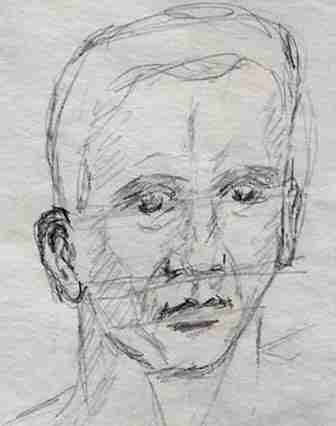
- Faces are usually lit from above, in which case the eyes—which are set in a concavity (rather than sitting right on the surface of the face)—are in a shadow cast by the ridge of the brow.
- The upper lip, which protrudes, is shadowed and darker than the lower lip, which catches the top lighting and often shows a highlight.
- The lower lip casts a shadow on the chin directly below it.
Elusive Likeness
Achieving a likeness is a matter of getting the proportions correct and capturing the tiny differences that make people's faces unique. Study your model carefully. It may be wise to begin with photographs, since they can “hold a pose” indefinitely. Does the bridge of the nose have a bump? Are the nostrils wider or narrower than most? Are the eyes wider or closer spaced? Are they set more deeply in the face? Do they have heavier eyelids? The planes of the face are captured by shadows, so if you set a model in a pose, make sure the light falls to define them.
Carry a sketchbook with you and catch quick sketches of people around you. Try to be unobtrusive about this—many people don't like being sketched. Practice with pictures from newspapers or magazines. Remember: The face isn't as large as your brain wants to make it, so correct for your subconscious.
Draw Faces
Draw Faces : Multi-thousand tips to make your life easier.
Faces hold a special place in human vision. Recognizing familiar faces actually takes place in a different part of the brain than recognizing, say, landmarks or letters of the alphabet. From an evolutionary standpoint, facial recognition may have evolved before less personal vision tasks. Consequently, drawing faces poses difficulties that drawing other objects does not.
The Amateur Approach
Because we put such a premium on faces, we subconsciously grant them too much “real estate” on the head.
Figure 1 shows a typical child's or beginning drawer's attempt at a human face. Starting with the standard egg shape, a child will divide the head into thirds, and put the nose in the center of the face. The eyes usually go on a line a third of the way down from the top of the head, and the mouth on a line a third of the way up from the chin. Another typical error is making the eyes too large. I've drawn a rounded triangle around the features to show how much space the face takes up in this childlike drawing.
Realistic Proportions
Figure 2 shows the real proportions of the features to the typical head. The eyes sit on a line halfway between the top and the bottom of the head. The nose is halfway between the eyes and the chin. The mouth's position varies but is usually one-third to one-half of the way between the nose and the chin. The ears are level with the eyebrows at the top and the end of the nose at the bottom. Here I also outline the features, and you can see the face is really a very small part of the entire head.
Drawing the Head
Figure 3 shows a sketch of a face drawn to these proportions. The head is slightly tilted and seen from above, so the lines will tilt and telescope accordingly.
- Faces are usually lit from above, in which case the eyes—which are set in a concavity (rather than sitting right on the surface of the face)—are in a shadow cast by the ridge of the brow.
- The upper lip, which protrudes, is shadowed and darker than the lower lip, which catches the top lighting and often shows a highlight.
- The lower lip casts a shadow on the chin directly below it.
Elusive Likeness
Achieving a likeness is a matter of getting the proportions correct and capturing the tiny differences that make people's faces unique. Study your model carefully. It may be wise to begin with photographs, since they can “hold a pose” indefinitely. Does the bridge of the nose have a bump? Are the nostrils wider or narrower than most? Are the eyes wider or closer spaced? Are they set more deeply in the face? Do they have heavier eyelids? The planes of the face are captured by shadows, so if you set a model in a pose, make sure the light falls to define them.
Carry a sketchbook with you and catch quick sketches of people around you. Try to be unobtrusive about this—many people don't like being sketched. Practice with pictures from newspapers or magazines. Remember: The face isn't as large as your brain wants to make it, so correct for your subconscious.
Draw Faces
By Howtodotips
Draw Faces : Multi-thousand tips to make your life easier.