Learn how to calculate your work hours and overtime to verify your expected pay. This guide covers understanding the basics, tracking hours, computing weekly wages, and includes a sample calculation.
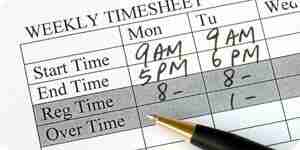
Calculation of work hours and overtime is tracked and monitored by the company’s human resources group. As an employee, however, it is wise for you to understand and know how to compute them in order for you to find out the pay that you will be expecting every cut off. This determines the wage that you will be receiving as your salary for the work that you have rendered. Work hours are simple as they can easily be accounted for through the login sheets or time cards used at the office. Follow the simple steps below on how to calculate your work hours and overtime.
Understand the basics. Take note that your regular pay will come from the regular hours of work that you render. This translates to eight working hours a day and forty working hours in a week. Hours that go beyond the eight per day and the forty per week are considered as overtime. Your hourly rate is the amount paid to you for every hour at work or rendering your service. Take note however that overtime pay is mandated by law to be paid at 1.5 times the regular hourly wage.
Track and compute your working hours. There are two sets of working hours that you need to track: regular working hours and overtime hours. This can be easily monitored by looking through your timecard or login sheet. All there is to know about this step is simple addition operation. Add up all the regular working hours and just the same, add up all your overtime hours. Make sure that computation for both are done separately.
Compute for your weekly wage. Get the working hours that you came up with to work on getting your weekly wage. There are two amounts that you need to compute for: the regular working hours and the overtime hours. Multiply the total regular working hours by your hourly rate. Just the same, multiply your overtime hours by 1.5 times of your hourly rate. Add the two amounts and the sum of these two will give you your weekly wage.
Try a sample computation: Lisa is a full-time employee and gets paid $15 dollars per hour of work rendered. In a week’s time, she rendered 50 working hours. Taking note of these details, it is easy to see that 40 hours out of the 50 is part of her regular working hours. The 10 hours then on top of the 40 is considered as overtime. Compute for Lisa’s regular hourly pay. Do this by multiplying her working hours which is 40 by her pay per hour which is $15. The product is $600. Compute now for her overtime pay: multiply her 10 hour overtime by 1.5 times of $15, which is her hourly rate. 10 times 22.5 (1.5 x $15) is $225. Add the two amounts: $600 + $225 = $825. This is Lisa’s weekly wage.
Calculating working hours and overtime is simple. It is important for employees to understand this process so that they may double-check how their salaries are computed and ensure that no mistakes were made in arriving at the amount.
Calculate Work Hours and Overtime
Learn how to calculate your work hours and overtime to verify your expected pay. This guide covers understanding the basics, tracking hours, computing weekly wages, and includes a sample calculation.
Calculation of work hours and overtime is tracked and monitored by the company’s human resources group. As an employee, however, it is wise for you to understand and know how to compute them in order for you to find out the pay that you will be expecting every cut off. This determines the wage that you will be receiving as your salary for the work that you have rendered. Work hours are simple as they can easily be accounted for through the login sheets or time cards used at the office. Follow the simple steps below on how to calculate your work hours and overtime.
Understand the basics. Take note that your regular pay will come from the regular hours of work that you render. This translates to eight working hours a day and forty working hours in a week. Hours that go beyond the eight per day and the forty per week are considered as overtime. Your hourly rate is the amount paid to you for every hour at work or rendering your service. Take note however that overtime pay is mandated by law to be paid at 1.5 times the regular hourly wage.
Track and compute your working hours. There are two sets of working hours that you need to track: regular working hours and overtime hours. This can be easily monitored by looking through your timecard or login sheet. All there is to know about this step is simple addition operation. Add up all the regular working hours and just the same, add up all your overtime hours. Make sure that computation for both are done separately.
Compute for your weekly wage. Get the working hours that you came up with to work on getting your weekly wage. There are two amounts that you need to compute for: the regular working hours and the overtime hours. Multiply the total regular working hours by your hourly rate. Just the same, multiply your overtime hours by 1.5 times of your hourly rate. Add the two amounts and the sum of these two will give you your weekly wage.
Try a sample computation: Lisa is a full-time employee and gets paid $15 dollars per hour of work rendered. In a week’s time, she rendered 50 working hours. Taking note of these details, it is easy to see that 40 hours out of the 50 is part of her regular working hours. The 10 hours then on top of the 40 is considered as overtime. Compute for Lisa’s regular hourly pay. Do this by multiplying her working hours which is 40 by her pay per hour which is $15. The product is $600. Compute now for her overtime pay: multiply her 10 hour overtime by 1.5 times of $15, which is her hourly rate. 10 times 22.5 (1.5 x $15) is $225. Add the two amounts: $600 + $225 = $825. This is Lisa’s weekly wage.
Calculating working hours and overtime is simple. It is important for employees to understand this process so that they may double-check how their salaries are computed and ensure that no mistakes were made in arriving at the amount.
Calculate Work Hours and Overtime
By Howtodotips
Learn how to calculate your work hours and overtime to verify your expected pay. This guide covers understanding the basics, tracking hours, computing weekly wages, and includes a sample calculation.