Prevent Engine Overheating
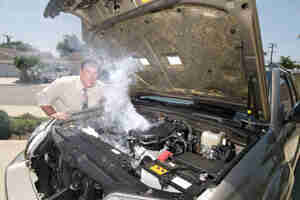
Engines burn gas and produce explosions in each cylinder. Rapid expansion from the explosions pushes the cylinder heads downward and does work to move the car. Much of the energy from each explosion does not do any work at all and is lost as heat. Over a short period, an engine can produce considerable amounts of heat. In fact, your engine can get hot enough to melt or weaken some of its parts.
The whole engine doesn't have to overheat for failure to occur. If only a single part of the engine overheats, the engine will begin to fail.
To keep your engine from overheating:
- Air-cooled engines: Most lawn mowers have air-cooled engines. These engines are designed with many cooling fins surrounding the cylinder heads, and air-cooled engines must have open access to incoming air to cool properly. Other vehicles with air-cooled engines are small airplanes and old Volkswagen Beetles. The advantages of air-cooled engines are that they have simple cooling systems that are lightweight, and there is no coolant that can freeze during winter. Disadvantages of air-cooled engines are that they require ample fresh air to remain cool, and it is more difficult to precisely control the overall engine temperature. The best way to improve cooling on an air-cooled engine is to make sure that it is not covered in dirt, grease, or any other substance that could prevent fresh air from contacting the engine metal.
- Liquid-cooled engines: Unless you have an old Volkswagen Beetle, your car has a liquid-cooled engine. The primary advantage of using a liquid-cooled engine is that the engine can be placed in a location with tight confines that doesn't require very much air passing over it to cool. Disadvantages include increased weight and the potential to develop localized hot spots.
- Components: Your engine cools important parts like the cylinder heads by running cooling fluid through channels built into the engine. It then travels through a temperature-activated valve called a thermostat. After passing the thermostat, the coolant goes into the radiator where it is cooled by air. Then the fluid travels back into the engine.
- Anti-freeze: Your car engine is cooled by water and ethylene glycol, which you usually call anti-freeze. Adding anti-freeze to the system reduces the freezing temperature of the fluid in the cooling system. Anti-freeze also raises the boiling temperature of water so that it can absorb more heat than water alone could. Most cars use half anti-freeze and half water for the cooling system. Never use water alone in your car's cooling system. Always make sure your car has sufficient coolant.
- Thermostat: The thermostat measures the coolant temperature and opens a valve only when the coolant reaches a sufficient operating temperature. If the thermostat is broken, the fluid in the engine will recirculate in the engine and bypass the radiator. The engine will quickly overheat. You can test for a broken thermostat by feeling the temperature of the coolant return hose to the radiator. The hose should become hot within minutes of starting the car.
- Fan: You should see a fan at the front of your engine compartment, just in front of the radiator. This fan is important for cooling the fluid in the radiator. There are two types of fans depending on whether you have a front-wheel drive car or a rear-wheel drive car. Front-wheel drive cars have electric fans that turn on and off according to temperature sensors. If your fan does not turn on in a front-wheel drive vehicle, the problem might be a bad fan motor. Rear-wheel drive vehicles have fans that are connected to the engine. With the engine and ignition off, try spinning the fan by hand. It should not turn easily. If it does, the fan clutch may need replacing.
- Leaks: Your coolant fluids may become low if there are any leaks in the system. If the car appears to be running hot, visually check for leaks while the engine is running. Check all of the hoses that feed the radiator. Also check that the radiator is not leaking. Sometimes a leak will develop on the seams of the radiator. Finally, check the water pump for leaks. A worn-out water pump will leak water out of an overflow hole. These leaks can range from a slow drip to a constant stream. Water pumps cannot be fixed or patched. If your water pump is leaking, replace it right away.
- Radiator cap: Finally, with the engine running and the hood up, watch for leaks around the radiator cap. If you notice any liquid escaping around the radiator cap, replace it. Never open a radiator cap when the fluid may be hot; boiling-hot fluids will spray out and cause serious burns. Too many foolishly try to remove a hot radiator cap. Don't do it!
Next, remove the oil cap and check for a white goop underneath the cap. If water is getting into places it shouldn't in the engine, it will mix with oil and produce a white gel. The only fix for internal water leaks is to find a broken gasket or part on the inside of the engine block. If this is the problem, take your car to a mechanic. This job is best left to professionals.
- Finally, the most important thing to remember when dealing with an engine that is running hot is that you must prevent it from overheating at all costs. Drive slower if you have to, turn on the heater, or just stop and turn the engine off.
Caution: Never allow an engine to run when the water temperature has exceeded the red line on your temperature gauge.
Quick Tips: If you are trying to get a hot, but not yet overheating, car to a safe stopping place, open the windows and turn on the heater to its highest setting. This removes heat from the cooling fluids and will provide a little extra cooling until you can stop.
Prevent Engine Overheating
Prevent Engine Overheating : Multi-thousand tips to make your life easier.
Engines burn gas and produce explosions in each cylinder. Rapid expansion from the explosions pushes the cylinder heads downward and does work to move the car. Much of the energy from each explosion does not do any work at all and is lost as heat. Over a short period, an engine can produce considerable amounts of heat. In fact, your engine can get hot enough to melt or weaken some of its parts.
The whole engine doesn't have to overheat for failure to occur. If only a single part of the engine overheats, the engine will begin to fail.
To keep your engine from overheating:
- Air-cooled engines: Most lawn mowers have air-cooled engines. These engines are designed with many cooling fins surrounding the cylinder heads, and air-cooled engines must have open access to incoming air to cool properly. Other vehicles with air-cooled engines are small airplanes and old Volkswagen Beetles. The advantages of air-cooled engines are that they have simple cooling systems that are lightweight, and there is no coolant that can freeze during winter. Disadvantages of air-cooled engines are that they require ample fresh air to remain cool, and it is more difficult to precisely control the overall engine temperature. The best way to improve cooling on an air-cooled engine is to make sure that it is not covered in dirt, grease, or any other substance that could prevent fresh air from contacting the engine metal.
- Liquid-cooled engines: Unless you have an old Volkswagen Beetle, your car has a liquid-cooled engine. The primary advantage of using a liquid-cooled engine is that the engine can be placed in a location with tight confines that doesn't require very much air passing over it to cool. Disadvantages include increased weight and the potential to develop localized hot spots.
- Components: Your engine cools important parts like the cylinder heads by running cooling fluid through channels built into the engine. It then travels through a temperature-activated valve called a thermostat. After passing the thermostat, the coolant goes into the radiator where it is cooled by air. Then the fluid travels back into the engine.
- Anti-freeze: Your car engine is cooled by water and ethylene glycol, which you usually call anti-freeze. Adding anti-freeze to the system reduces the freezing temperature of the fluid in the cooling system. Anti-freeze also raises the boiling temperature of water so that it can absorb more heat than water alone could. Most cars use half anti-freeze and half water for the cooling system. Never use water alone in your car's cooling system. Always make sure your car has sufficient coolant.
- Thermostat: The thermostat measures the coolant temperature and opens a valve only when the coolant reaches a sufficient operating temperature. If the thermostat is broken, the fluid in the engine will recirculate in the engine and bypass the radiator. The engine will quickly overheat. You can test for a broken thermostat by feeling the temperature of the coolant return hose to the radiator. The hose should become hot within minutes of starting the car.
- Fan: You should see a fan at the front of your engine compartment, just in front of the radiator. This fan is important for cooling the fluid in the radiator. There are two types of fans depending on whether you have a front-wheel drive car or a rear-wheel drive car. Front-wheel drive cars have electric fans that turn on and off according to temperature sensors. If your fan does not turn on in a front-wheel drive vehicle, the problem might be a bad fan motor. Rear-wheel drive vehicles have fans that are connected to the engine. With the engine and ignition off, try spinning the fan by hand. It should not turn easily. If it does, the fan clutch may need replacing.
- Leaks: Your coolant fluids may become low if there are any leaks in the system. If the car appears to be running hot, visually check for leaks while the engine is running. Check all of the hoses that feed the radiator. Also check that the radiator is not leaking. Sometimes a leak will develop on the seams of the radiator. Finally, check the water pump for leaks. A worn-out water pump will leak water out of an overflow hole. These leaks can range from a slow drip to a constant stream. Water pumps cannot be fixed or patched. If your water pump is leaking, replace it right away.
- Radiator cap: Finally, with the engine running and the hood up, watch for leaks around the radiator cap. If you notice any liquid escaping around the radiator cap, replace it. Never open a radiator cap when the fluid may be hot; boiling-hot fluids will spray out and cause serious burns. Too many foolishly try to remove a hot radiator cap. Don't do it!
Next, remove the oil cap and check for a white goop underneath the cap. If water is getting into places it shouldn't in the engine, it will mix with oil and produce a white gel. The only fix for internal water leaks is to find a broken gasket or part on the inside of the engine block. If this is the problem, take your car to a mechanic. This job is best left to professionals.
- Finally, the most important thing to remember when dealing with an engine that is running hot is that you must prevent it from overheating at all costs. Drive slower if you have to, turn on the heater, or just stop and turn the engine off.
Caution: Never allow an engine to run when the water temperature has exceeded the red line on your temperature gauge.
Quick Tips: If you are trying to get a hot, but not yet overheating, car to a safe stopping place, open the windows and turn on the heater to its highest setting. This removes heat from the cooling fluids and will provide a little extra cooling until you can stop.
Prevent Engine Overheating
By Howtodotips
Prevent Engine Overheating : Multi-thousand tips to make your life easier.