Create separate workspaces while enhancing your office design with the right partitions.
At their best, office partitions go unnoticed as neutral elements in our work landscape. At worst, partitions can feel like oppressive, trap-like mazes. Whether they are meant to seem permanent or can be opened and closed with ease, the less we think about office partitions, the better they generally are. Therefore, though choosing them might not seem like a weighty decision, think again—your employees' morale can sometimes depend on it. The good news is that you have many options when selecting office partitions. Here is how to choose this important element of office design:
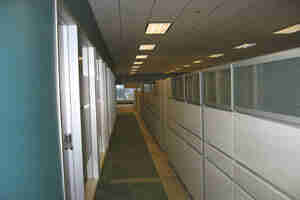
- When you pop your head over an office cubicle wall and catch your neighbor shopping online or updating their blog, you are peering over a partition. Some people think the terms "office partitions" and "cubicles" are synonymous, but they are wrong! In fact, cubicles are only one kind of partition available to you. The cubicle style is commonly known as half height.
- Some office dividers stretch from floor to ceiling. Appropriately enough, these are called either floor-to-ceiling or full height. Although these partitions fully enclose a person and, some might argue, impede visibility throughout the office, they also lend an air of permanence. They feel less like "partitions" and more like actual "walls." However, even though they appear permanent, they can be rearranged or removed in short order. So, do you want your office to have a greater sense of openness, or do you prefer the solid, permanent feel of full-height dividers?
- If your answer to that last question is "neither," you are still in luck. Perhaps you are looking for something that can offer full enclosure while still allowing for the openness that full-height versions cannot accommodate. If that is the case, your best bet may be accordion walls. You might remember these from high school, where they are often used to separate (and sometimes unite) adjoining classrooms. When slid shut, these partitions act as complete walls, but when opened, they create no barrier whatsoever.
 Your least permanent option is the portable variety. These partitions are similar to accordion walls only in that they can expand and contract. Unlike accordion walls, however, portable partitions can easily be picked up, rolled on wheels, or otherwise moved from one place to another. In other words, it takes minutes to move or take them down, as opposed to the hours it takes to disassemble and move full-height dividers.
Here are some handy tips for finding a dealer once you have an idea of the kind of partitions you want:
- Visit the Blue Book locator online to find local office partition dealers.
- A search on Google or Yahoo for "office partitions" or "office cubicles" turns up many manufacturer websites, as well as sites that list numerous makers. A wide search like this is valuable to give you a better appreciation for the variety of products available to choose from.
- Talk to your building manager. It is very likely that they can recommend local businesses.
How to Choose Office Partitions
Create separate workspaces while enhancing your office design with the right partitions.
At their best, office partitions go unnoticed as neutral elements in our work landscape. At worst, partitions can feel like oppressive, trap-like mazes. Whether they are meant to seem permanent or can be opened and closed with ease, the less we think about office partitions, the better they generally are. Therefore, though choosing them might not seem like a weighty decision, think again—your employees' morale can sometimes depend on it. The good news is that you have many options when selecting office partitions. Here is how to choose this important element of office design:
- When you pop your head over an office cubicle wall and catch your neighbor shopping online or updating their blog, you are peering over a partition. Some people think the terms "office partitions" and "cubicles" are synonymous, but they are wrong! In fact, cubicles are only one kind of partition available to you. The cubicle style is commonly known as half height.
- Some office dividers stretch from floor to ceiling. Appropriately enough, these are called either floor-to-ceiling or full height. Although these partitions fully enclose a person and, some might argue, impede visibility throughout the office, they also lend an air of permanence. They feel less like "partitions" and more like actual "walls." However, even though they appear permanent, they can be rearranged or removed in short order. So, do you want your office to have a greater sense of openness, or do you prefer the solid, permanent feel of full-height dividers?
- If your answer to that last question is "neither," you are still in luck. Perhaps you are looking for something that can offer full enclosure while still allowing for the openness that full-height versions cannot accommodate. If that is the case, your best bet may be accordion walls. You might remember these from high school, where they are often used to separate (and sometimes unite) adjoining classrooms. When slid shut, these partitions act as complete walls, but when opened, they create no barrier whatsoever.
- Your least permanent option is the portable variety. These partitions are similar to accordion walls only in that they can expand and contract. Unlike accordion walls, however, portable partitions can easily be picked up, rolled on wheels, or otherwise moved from one place to another. In other words, it takes minutes to move or take them down, as opposed to the hours it takes to disassemble and move full-height dividers.
Here are some handy tips for finding a dealer once you have an idea of the kind of partitions you want:
- Visit the Blue Book locator online to find local office partition dealers.
- A search on Google or Yahoo for "office partitions" or "office cubicles" turns up many manufacturer websites, as well as sites that list numerous makers. A wide search like this is valuable to give you a better appreciation for the variety of products available to choose from.
- Talk to your building manager. It is very likely that they can recommend local businesses.
How to Choose Office Partitions
By Howtodotips
Create separate workspaces while enhancing your office design with the right partitions.